Targeted removal of sun spots, age spots and melasma, for a more even complexion.
Pigment can be caused by the sun, hormones or inflammation. With a skin analysis, we see how deep the pigment lies and choose the treatment accordingly.
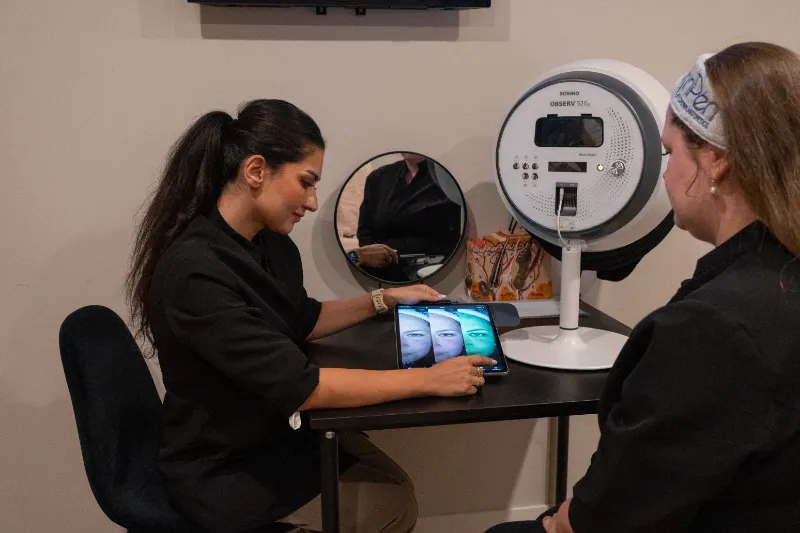
For pigmentation we work with the Nordlys, SkinPen, KTP, Alexandrite, chemical peels and the OBSERV 520x. Which technique we use depends on your skin type and the type of pigmentation concern. With the OBSERV 520x we first show what is happening beneath the surface. Would you like a complete plan with products for home use? Then take a look at our skin treatment plans.


Four steps, always in this rhythm. You know in advance what happens and what it costs.
We look at your skin and your hair type and discuss what you want to achieve.
Together we draw up a plan: which technique, how many sessions, how many weeks in between and the total cost.
Following proven protocols, by our skin therapists and skin specialists. Your progress is recorded in your file, so we know exactly how your skin responds.
After each session you receive aftercare advice. In between, we adjust until you have the result you wanted.
The price depends on the type of pigment problem and the size of the treatment area. During the intake with skin analysis we determine which treatment your skin needs and what it costs. Would you like a complete plan with products for home use? Then take a look at our skin programmes.
Three clinics in Amsterdam, Arnhem and Amersfoort. The same approach everywhere and an intake to get started.
What you can expect from a pigment treatment.
✓The light is absorbed by the pigment and breaks it down.
✓The spot first becomes darker and then flakes off.
✓For two weeks before and after a session, no sunbeds or unprotected sun.
✓Afterwards, use a high-factor sunscreen every day.
✓Melasma calls for a gentle approach, often with peels and products for home use.
✓We discuss in advance what you can expect.
✓On average three to five sessions.
We will discuss the number of sessions and the cost during the intake. Would you like a complete plan with products for home use? Then take a look at our skin programmes.
Pigment has various causes. That is why we first look at what is going on.
Per session we record how your skin responds.
Pigment spots develop when the skin produces more pigment in a particular place. Common causes are sun, hormones, inflammation and ageing. There are different types, such as sun spots, age spots and freckles, and not every spot needs the same treatment.
A spot that changes in shape, colour or size should first be assessed by a doctor. We only treat spots that are clearly harmless pigment spots.
First, we perform a skin analysis with the OBSERV 520x so we can see what is happening beneath the surface. Then we choose the technique that suits your spots, such as IPL or laser. This way we address the cause and not just what is visible.
Sun is the main cause of new pigment spots. That is why good sun protection is essential: a high-factor sunscreen every day, even in winter. We advise you on this during the intake.
Avoid sun and sunbeds before and during your treatment programme, do not use self-tanner, and come with clean, non-irritated skin. Let us know about any new medication or antibiotics and protect your skin daily with SPF 50+. Do not pick at flaking skin, and contact us if you are unsure about a skin reaction.
To carry out the treatment safely and effectively, we ask you to keep the following in mind:
After the treatment, the skin may feel warm, red or sensitive. This is a normal skin reaction and usually subsides within a few hours to a few days.
The treated pigment may first darken after the treatment. This is a normal reaction. During the healing process, the pigment rises to the surface, after which your body starts to clear it naturally. After about 14 to 21 days, the pigment usually becomes lighter.
In the days after the treatment, the skin may become a little dry, start to flake lightly or peel. Do not pick at loose flakes or peeling skin. This can disrupt the healing process and damage your skin.
Important to note:
After the treatment, it is important to let your skin recover calmly.
Use only gentle skincare and temporarily avoid products with active ingredients such as acids, retinol or exfoliants until your skin has fully settled.
Use a repairing cream according to your personal product advice. Alhydran may be part of this advice and helps to calm the skin and support the recovery of the skin barrier.
Not sure whether you may use a product? Please always get in touch with us.
After a pigmentation treatment, your skin is temporarily more sensitive to UV radiation. We therefore advise you to be careful with sun exposure throughout your entire treatment programme and to avoid sunbeds.
When the skin is sun-tanned, we cannot carry out the treatment safely. The Nordlys works on pigment. When extra pigment is present in the skin due to sun or sunbeds, the risk of pigment shifts, burns or, in exceptional cases, permanent skin damage increases.
If you do go outside, use SPF 50+ daily. On sunny days, we advise reapplying sunscreen several times a day. With prolonged sun exposure, sunscreen alone is not always sufficient. In that case, make sure the treated area is also well protected or covered with clothing, a cap or a hat.
Before every treatment, we assess your skin condition. If your skin is too tanned or if we cannot carry out the treatment safely, the practitioner may decide to postpone the treatment. Your safety and skin health always come first.
Every skin responds differently to treatments. The average number of treatments we mention on the website or during the consultation is therefore always an indication.
Factors such as skin type, depth of the pigment, location of the pigment, lifestyle, hormones, medication, sun exposure, product use and following advice can all affect the final result. In some cases, more treatments are needed than expected in advance.
It is important to leave enough time between treatments. For treatments on the face, we advise at least 4 weeks between appointments, and for the body at least 6 weeks. During this period, your body is busy clearing the treated pigment. Treating sooner does not produce faster results, so it is not recommended.
Pigment can reappear over time due to sun exposure, hormonal influences, skin type or predisposition. Maintenance treatments may therefore be desirable.
Because every skin and every body's reaction is unique, we cannot guarantee an exact final result or the number of treatments required.
Do you become pregnant during your treatment programme? Please let us know. During pregnancy, we temporarily pause the treatment programme.

Treated spots disappear, but sunlight can cause new pigment. Using a high-factor sunscreen every day helps prevent this.
In autumn and winter, when you spend less time in the sun.
Treated spots can return if the skin gets a lot of sun again. Using a high-factor sunscreen every day reduces that risk. Sometimes a maintenance treatment is useful.
After a treatment, a spot may first become darker and then gradually fade. The final result is usually visible after a few weeks.
The most important thing is protection from the sun: a high-factor sunscreen every day, seeking shade and avoiding sunbeds. Good skincare helps keep the skin in balance.