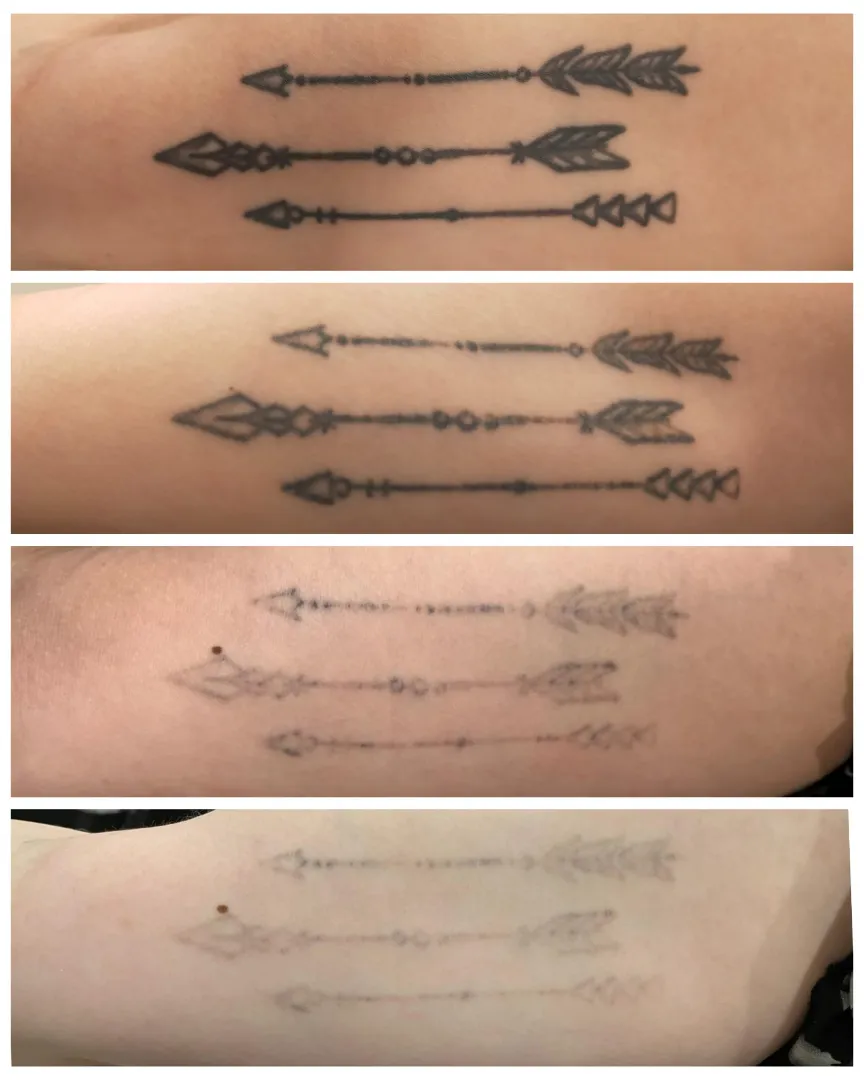
Complete removal or fading for a cover-up, with the Fotana StarWalker. Also on difficult colours.
Would you like a tattoo removed or faded for a cover-up? We work with the advanced StarWalker, a powerful and precise laser technology for removing tattoos. The StarWalker laser uses ultra-short laser pulses that break down the ink pigments in the skin. The body then naturally removes these particles. With this innovative technology we treat black, red, blue and green ink. The number of treatments depends on the quality of the tattoo work, the colour and the depth of the tattoo. During a personal consultation (intake) we assess your tattoo and draw up a suitable treatment plan, with attention to safety, skin recovery and the best possible result.
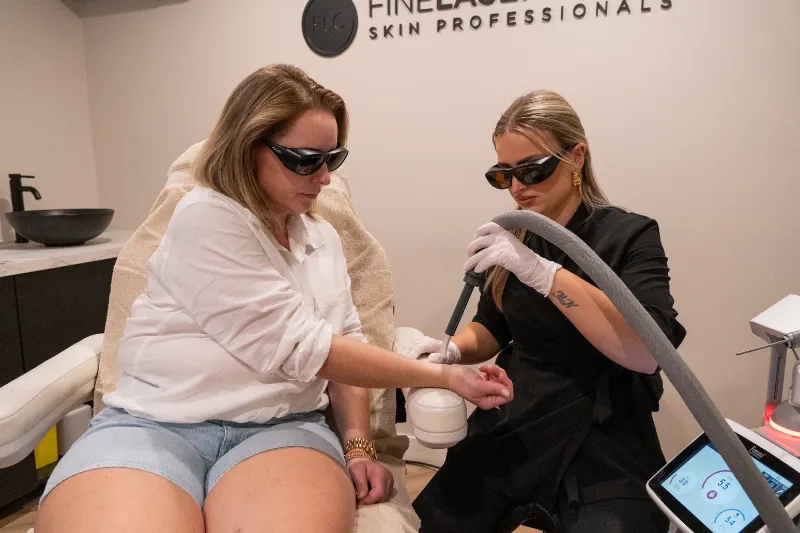
The StarWalker works with multiple wavelengths, so we choose the right setting for each colour. This breaks down the pigment in a targeted way and spares the surrounding skin as much as possible.


Four steps, always at this pace. You know in advance what happens and what it costs.
We look at your skin and hair type and discuss what you want to achieve.
Together we draw up a plan: which technique, how many sessions, how many weeks between them and what it costs in total.
Following proven protocols, by our skin therapists and skin specialists. Your progress is recorded in your file, so we know exactly how your skin responds.
After every session you receive aftercare advice. In between, we adjust the plan until you have the result you wanted.
Single treatments or a course of five with one free.
Three clinics in Amsterdam, Arnhem and Amersfoort. The same approach everywhere, starting with a consultation (intake).
What to expect when removing a tattoo.
✓The laser breaks the ink down into tiny particles.
✓Your body then clears them away naturally.
✓Want a new tattoo? Then we fade the old one.
✓That usually takes fewer sessions.
✓The area may be red and swollen for a few days.
✓Keep the area clean and dry, and avoid the sun.
✓Usually 6 to 12 sessions, depending on colour and size.
Single treatments are always possible. A course of five with one free is better value and can be paid in three instalments.
We give the skin time to recover and clear the ink.
At each session we review the progress together.
We remove tattoos in different colours, from black to coloured tattoos. Each colour absorbs light of a different wavelength, which is why a suitable wavelength is needed for each colour. Black ink is usually the easiest to remove. Some colours, such as light green or yellow, are more difficult. We also treat medical tattoos, such as radiotherapy marker dots after breast cancer. Read more about the treatment of radiotherapy marker dots.
How many sessions are needed depends on, among other things, the amount, type and colour of the ink, the depth of the ink, how long the tattoo has been there and the location on the body. During the consultation (intake) we assess your tattoo and give an indication of the number of sessions and the costs.
The laser breaks the ink particles in your skin into smaller particles. Your body then gradually clears them away itself. That is why you see the tattoo fade further after each session. There is usually eight to twelve weeks between sessions so that the skin can recover.
After the treatment the skin may be red. You will receive aftercare advice and we advise sun protection throughout the entire course.
Avoid sun and sunbeds before and during the treatment course, cool only indirectly and do not pick at crusts or flakes. Do not burst blisters and keep the skin clean and dry during the first few days. Contact us straight away if pain increases, the skin reaction gets worse or large blisters appear. Contact us before your appointment and report any new medication or antibiotics.
To carry out the treatment safely and effectively, we ask you to keep the following in mind:
After the treatment we apply a protective cream and cover the tattoo with a gauze pad. This gauze may stay on for a few hours. After that you may gently remove it.
You may experience some discomfort after the treatment. Because warmth builds up in the skin during the treatment, the treated area may continue to glow for a while. If you want to cool the skin, always do so in a gentle and indirect way. Never place a cold pack directly on the skin.
Immediately after the treatment a light whitening may be visible on the treated area. This is also called laser snow. Redness, swelling and small pinpoint bleeding may also occur. These are normal skin reactions and usually fade within 2 to 48 hours. Crusts, flakes or small blisters may also develop. This is part of the skin's healing process.
Important:
Contact us straight away if the skin reaction gets worse, if you have a lot of pain, if large blisters develop, or if you are unsure whether healing is progressing normally. Preferably send a clear photo, so we can better assess the skin reaction.
After the treatment we recommend caring for the skin at least twice a day with Alhydran. Do this for at least 1 week after the treatment, or longer if the skin is still dry, sensitive or healing. Alhydran is a protective and restorative cream that supports the skin barrier. Good aftercare helps the skin recover calmly and reduces the risk of irritation, crusting or disruption of the healing process.

Do you experience a lot of pain during the treatment? Then lidocaine/prilocaine cream may be an option at a future appointment.
This numbing cream is available from your GP. Using numbing cream? Then we ask you to apply a thick layer about 1 hour before the treatment and cover it with cling film. We will remove the cream at the clinic before we start the treatment.
This is not our standard preference. Numbing cream can make the skin softer, so the laser sometimes reaches the ink less effectively and the result may be less optimal.
Only use numbing cream on closed, intact skin. Always follow the instructions in the leaflet. Are you allergic to numbing cream, or are you unsure whether you can use it safely? Then first consult your GP or pharmacist.
Throughout the entire treatment course we advise you to be careful with sun exposure and sunbeds.
Avoid sun and sunbeds for 4 weeks before and after the treatment. Exposure to UV radiation can cause hyperpigmentation or hypopigmentation.
Tanned skin cannot be treated safely, because the laser responds to pigment. This increases the risk of pigment shifts, burns or, in exceptional cases, permanent skin damage.
Do you go out in the sun anyway? Then make sure the area with the tattoo is well protected and covered with clothing, a plaster, sports tape or another protective dressing. Also use SPF 50+ daily. Sunscreen alone is not always sufficient with direct sun exposure.
Before every treatment we assess the skin condition. If the skin is too tanned or we cannot carry out the treatment safely, the practitioner may decide to postpone the treatment. Your safety and skin health always come first.
It is important to keep at least 8 weeks between treatments. During this period the body is busy clearing the ink particles. Scheduling treatments closer together does not produce faster results.
Every skin and every tattoo responds differently to laser treatments. The average number of treatments we mention on the website or during the intake is therefore always an indication.
Factors such as the depth of the ink, colour use, skin type, lifestyle, medication, sun exposure and following advice can affect the final result. In some cases more treatments are needed than expected in advance. Because every skin, tattoo and bodily reaction is unique, we cannot guarantee an exact final result or the number of treatments required.
Do you become pregnant during the treatment course? Please let us know. During pregnancy we temporarily pause the treatment course.
Usually 6 to 12 treatments are needed, depending on the colour intensity and the size of your tattoo.
Eight to twelve weeks, so that your body can clear the ink.
You feel a brief, sharp snap, similar to a rubber band against the skin. The treatment usually lasts only a short time, depending on the size of the tattoo.
It varies from tattoo to tattoo. Small, black tattoos often need fewer sessions than large, multi-coloured tattoos. After the intake you will receive an estimate.
With careful treatment and good aftercare the chance of scarring is small, but we cannot rule it out entirely. We will discuss this with you in advance during the intake.