

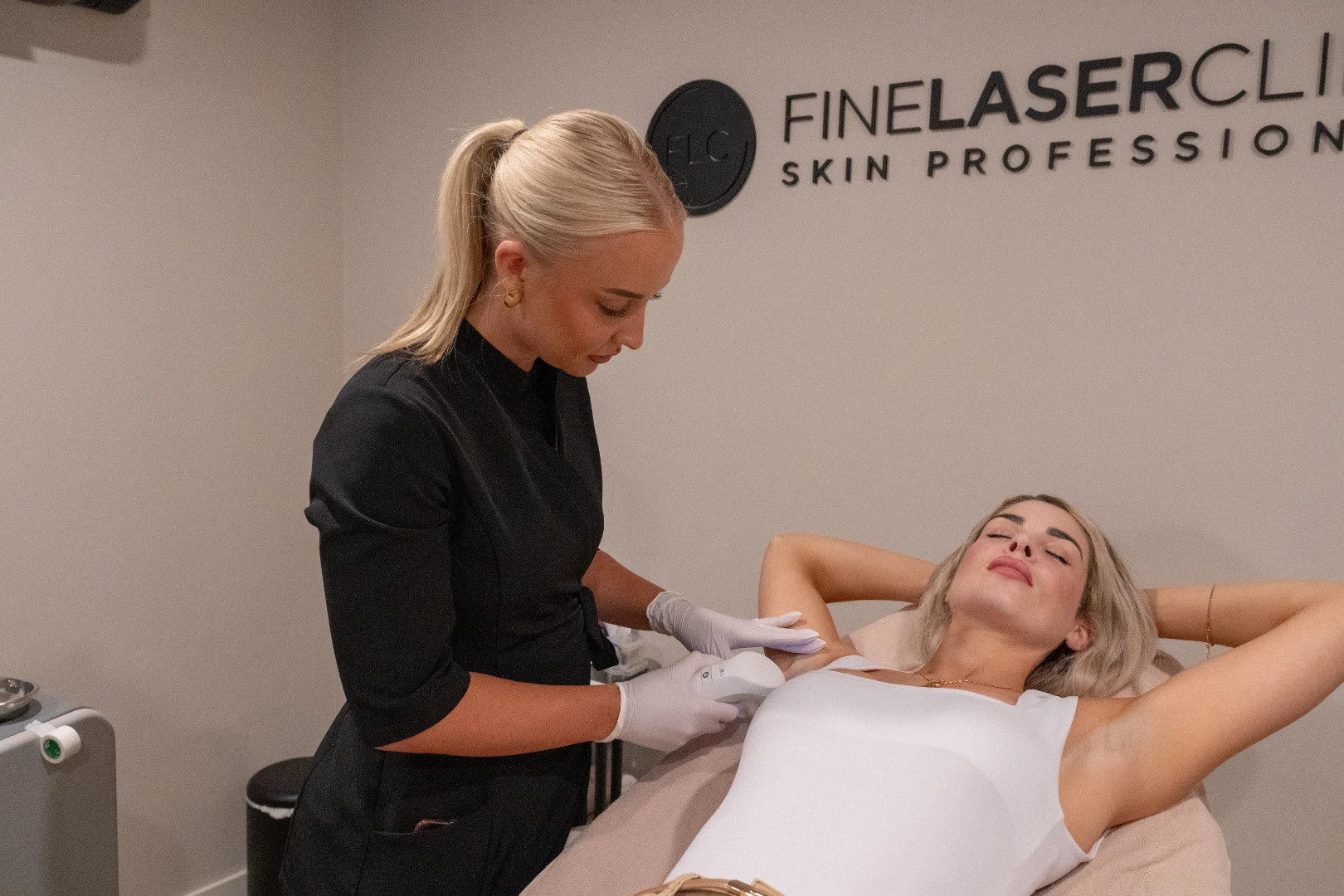
Well prepared for your appointment
Soon we will welcome you to Fine LaserClinic for a treatment with our CO₂ laser, the Lasering Slim Evolution II.
This laser is used for skin improvement, scar treatments and the removal of selected benign skin blemishes.
Depending on the skin indication, we treat the skin fractional ablative or fully ablative.
In a fractional ablative treatment, microscopically small treated zones are created in the skin. In a fully ablative treatment, the treated skin surface is removed in a controlled way.
With both techniques, the skin barrier is temporarily damaged. Good wound care is therefore essential for careful recovery.
You will receive this information at your appointment. Please read through this page calmly and completely in advance, so you know what to expect and how to care for your skin after the treatment.
If your treatment plan differs, other arrangements are made or additional advice is needed, we will confirm this by email. Always follow the personal instructions of your practitioner.
Avoid sun and sunbeds, do not use irritating skin products beforehand, and come with clean skin. After the treatment the skin is extra vulnerable. Use only the recommended aftercare products, let scabs and flakes of skin come off on their own, and protect the skin against infection and sunlight. Contact us directly if the skin reaction clearly worsens.
To carry out the treatment safely and effectively, we ask you to take the following into account:
Before the treatment, we assess the skin condition and discuss the recovery period you can expect.
Because the skin is temporarily damaged after an ablative laser treatment, it is important to schedule enough time for recovery.
The skin reaction depends on the chosen treatment method, the treatment intensity and the treated area.
In a fractional ablative CO₂ treatment, microscopically small treated zones are created in the skin. The surrounding skin remains partly intact and supports the healing process.
During the treatment, controlled heat is created in the skin. This stimulates processes involved in skin renewal and collagen formation.
Directly after the treatment, the skin may feel red, warm, swollen or stinging. This can be comparable to a strong sunburn.
Clear or light pink wound fluid may also be released temporarily. This can be a normal reaction during the first phase of wound healing.
In the first few days, the skin may darken, feel dry and tight, or develop a rough texture.
Small dark dots, flakes of skin or scabs may form. These will come off on their own as the skin renews itself.
With a lighter treatment, the skin surface often recovers within about 5 to 7 days.
With more intensive or deeper treatments, this can take 7 to 16 days or longer.
Redness or a pink skin colour may remain visible for longer, sometimes for several weeks.
A pattern of small dots may also remain temporarily visible. This is because the laser treats the skin in a fractional way.
This pattern usually gradually fades during natural recovery.
Where visible dots or texture differences remain after full recovery, we assess whether additional skin improvement is needed. In certain cases a peel may be suitable. This is only considered when the skin has recovered sufficiently.
Important:
With a fully ablative CO₂ treatment, the superficial layer of skin in the treated area is removed in a controlled way.
This creates an open wound surface that needs to heal again.
In addition to evaporating skin tissue, the CO₂ laser also produces heat and coagulation. As a result, small blood vessels may be partly sealed off.
Even so, wound fluid may be released after the treatment. This depends on the treatment depth, the size of the wound surface and the individual wound healing.
Directly after the treatment, the skin may be red, raw, swollen and sensitive.
The wound surface may be moist, and clear or light pink wound fluid may be released.
During the first phase of wound healing, this can be a normal reaction.
It is important that the wound is cared for according to your personal wound care protocol. Good wound care helps to restore the skin barrier and reduces the chance of complications.
Depending on the depth and size of the treatment, it often takes about 1 to 3 weeks before the skin has closed again.
With deeper or more intensive treatments, this can take longer.
Even after the skin has closed, the treated area may remain pink or red for weeks to months.
The new skin is vulnerable and must be protected carefully.
Important:
A fully ablative treatment usually has a longer recovery period and carries a greater risk of pigment changes, infections and scarring than a superficial fractional treatment.
The right aftercare depends on the intensity of the treatment and the condition of the skin.
During the first few days, use only the products we have personally recommended to you.
A suitable skin-restoring cream can help to support the skin barrier and limit moisture loss.
Alhydran may be part of the aftercare when this is appropriate according to the treatment protocol.
If the skin is still open or clearly moist, additional wound care or another product may be needed.
Do not use your own skin products while the skin is still open, moist or clearly damaged.
Once the skin is fully closed, normal skin care can gradually be resumed according to your personal product advice.
After a fully ablative treatment, there is an open wound surface.
It is important that the wound is cared for according to the personal wound care protocol you have been given.
Depending on the treatment, a specific wound ointment, a protective dressing or other wound products may be advised.
Good wound care helps prevent the wound surface from drying out or, conversely, remaining too moist for a long time.
Do not use other creams, oils, disinfectants or active skin products on the treated area on your own initiative.
Once the skin has fully closed, you can switch to restorative skin care according to the advice of your practitioner.
Alhydran may be part of your personal product advice during this recovery phase.
Not sure whether you may use a product? Always contact us first.
For scar and skin improvement treatments, the skin needs time to form new skin structures and collagen.
The visible healing of the skin surface is therefore not the same as the final result of the treatment.
Improvement can develop over several months.
For scars that have developed recently, additional scar care may be advised.
Silicone gel may be suitable, for example, once the skin has fully closed. Use it according to your personal product advice.
The effect of the treatment depends on the type of scar, its depth, the age of the scar and the individual wound healing.
Deep or adhered scars may require several treatments and do not always disappear completely.
The aim of the treatment is to improve the skin structure and the appearance of the scar where possible.
When selected benign skin blemishes are removed fully ablatively, a small wound is created at the treated spot.
Directly after the treatment, the skin may be red, sensitive or slightly swollen.
Wound fluid may also be released temporarily, or a scab may form.
Depending on the size and depth, the small wound may close within about 1 to 3 weeks.
After healing, the skin may be temporarily pink, red, lighter or darker.
There is a risk of a permanent change in colour or a small scar.
For this reason, we assess in advance which skin blemishes are suitable for laser treatment.
Skin conditions whose benign nature is not sufficiently established are not removed cosmetically without medical assessment.
When tissue examination is needed, a treatment that destroys the tissue is not suitable.
After an ablative CO₂ treatment, the skin is extra sensitive to UV radiation.
We advise avoiding direct sun exposure for at least 8 weeks after the treatment.
With more intensive treatments, persistent redness or an increased risk of pigment formation, a longer protection period may be needed.
Do not use a sunbed during recovery.
Once the skin has fully closed, use SPF 50+ daily and additionally protect the area with suitable clothing or other physical sun protection.
When exposed to the sun, reapply sunscreen regularly, preferably every 2 hours when you are outdoors.
While the skin is still open, do not apply sunscreen directly to the wound surface.
Even when the skin appears to have healed on the outside, it may remain sensitive to UV radiation for a long time.
Good sun protection supports the recovery process and reduces the chance of hyperpigmentation, hypopigmentation and other unwanted skin reactions.
Every skin reacts differently to CO₂ laser treatments.
Redness, swelling, scab formation, wound fluid and temporary pigment changes may be part of the recovery.
Possible complications include infections, prolonged redness, hyperpigmentation, hypopigmentation and scarring.
With intensive treatments, these risks may be greater.
The average number of treatments we mention on the website or during the consultation is always an indication.
Factors such as skin type, scar depth, skin condition, age, lifestyle, medication, sun exposure and following aftercare advice influence recovery and results.
It is important to give the skin enough time to recover before a next treatment is carried out.
The final result can develop over several months.
Because every skin is unique, we cannot guarantee an exact end result or the number of treatments needed.
Are you pregnant or breastfeeding? Please let us know.
During pregnancy, we postpone cosmetic CO₂ laser treatments.
During breastfeeding, we assess which treatments and any additional products or medication are suitable.
After a fractional or fully ablative CO₂ treatment, wound fluid may be released temporarily. This can be a normal reaction as long as it fits the expected recovery.
Contact us directly when:
Preferably send a clear photo, so that we can better assess the skin reaction.
In case of serious complaints, a suspected infection or when you cannot reach us, contact your GP or the out-of-hours GP service on the same day.
Do you still have questions after reading this information, or are you unsure about anything? Feel free to contact us at info@finelaserclinic.nl. We are happy to help and look forward to welcoming you to Fine LaserClinic soon.
Prefer to call? Call the clinic nearest you: