

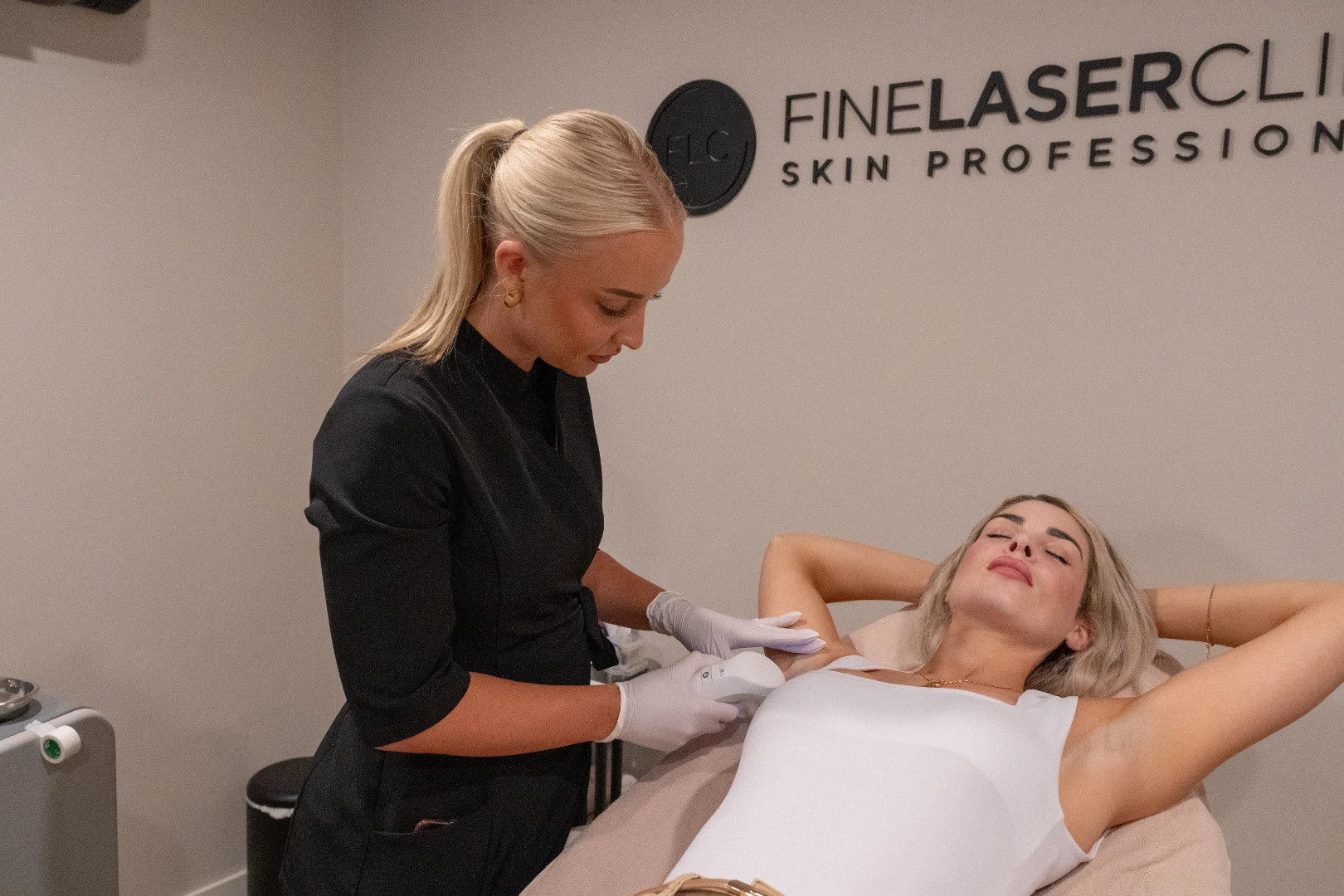
Well prepared for your appointment
We look forward to welcoming you soon at Fine LaserClinic for a treatment with the KTP S5 Velure. This laser can be used to treat superficial blood vessels, certain pigment irregularities and selected benign skin blemishes.
Good preparation and appropriate aftercare are important to carry out the treatment carefully and allow the skin to recover calmly.
You will receive this information at your appointment. Take your time to read through this page beforehand, so you know how to prepare your skin, which skin reactions to expect and which skincare is important after your treatment.
If your treatment plan deviates, other appointments are made or additional advice is needed, we will confirm this by email. Always follow the personal instructions of your practitioner.
Avoid sun and sunbeds, come with clean skin and report any changes in your medication. Cool the skin only indirectly and do not pick at scabs or flakes of skin. Apply SPF 50+ daily to closed skin and contact us if the skin reaction worsens or if you are unsure about the recovery.
To carry out the treatment safely and effectively, we ask you to take the following into account:
Before the treatment we assess your skin condition and the skin concern to be treated. If the skin is too tanned or irritated, the treatment may be postponed.
The skin reaction depends on what we are treating. Below you can read which reactions may occur for the different indications.
When treating superficial blood vessels, the skin may be red, warm or slightly swollen immediately after the treatment. This usually subsides within a few hours to a few days.
The treated blood vessels may become less visible straight away, but sometimes they first appear darker or temporarily more visible.
With certain vessel treatments, small reddish-purple discolourations may develop. These may remain visible for a few days up to about 2 weeks.
Sometimes slight swelling occurs, especially with treatments on the face or around the nose.
The body needs time to gradually clear the treated blood vessels. The final result is therefore not always visible immediately.
Important:
Everyday influences such as temperature differences, smoking, alcohol, flushing and hormonal changes can cause blood vessels to become visible again or new ones to develop.
Hereditary predisposition and the natural ageing of the skin also play a role. As a result, maintenance treatment may be needed after some time.
After a pigment treatment the skin may temporarily feel red, warm or sensitive.
The treated pigment may become darker during the first few days. This is a common reaction to superficial pigment treatments.
In the following days, small dark dots, flakes of skin or scabs may develop. The pigment may then gradually become lighter as the skin renews itself.
This process often takes about 1 to 3 weeks, depending on the depth of the pigment and the intensity of the treatment.
The final result can only be properly assessed after a few weeks.
Important:
Pigment may reappear over time as a result of sun exposure, hormonal influences, skin type or predisposition.
That is why good sun protection remains important after the treatment course too.
When small benign skin blemishes are treated, a superficial wound or scab may develop.
The skin may be red and sensitive immediately after the treatment. In the days that follow, a scab may form that protects the underlying skin during healing.
Let the scab come off on its own. Pulling at it can damage the skin again and increases the risk of pigment changes or scarring.
The superficial skin usually closes within about 1 to 2 weeks, depending on the size, location and depth of the treatment. A deeper or larger wound may take longer to heal.
After the skin has closed, the treated spot may still be pink, red, lighter or darker in colour for some time.
Important:
Skin blemishes are only treated once it has been established beforehand that they are benign.
If you have doubts about the nature of a skin condition, we will first refer you to a doctor. Where tissue examination is needed, a treatment that destroys the tissue is not suitable.
After the treatment it is important to let the skin recover calmly.
Use only gentle skincare and temporarily avoid products with active ingredients such as acids, retinol or exfoliants.
A skin-repairing cream is part of your personal product advice.
Alhydran may be recommended to hydrate the skin, support the skin barrier and care for the skin during recovery.
For an open or moist wound, a different form of wound care may be needed. Only use Alhydran on these areas when this is explicitly part of your personal wound care advice.
It is important that a wound is cared for correctly, so that it does not dry out unnecessarily or remain too moist for a long time.
Therefore, only use the wound products and any dressings that we have advised.
Not sure whether you may use a product? Please contact us.
After a KTP laser treatment, the skin is temporarily more sensitive to UV radiation.
We advise avoiding direct sun exposure and sunbeds for at least 4 weeks after the treatment.
With pigment treatments, or when the skin takes longer to recover, a longer protection period may be needed.
Apply SPF 50+ daily once the skin has closed. When exposed to sun, reapply sunscreen regularly, preferably every 2 hours when you are outdoors.
While the skin is still open, protect the area with suitable physical covering instead of applying sunscreen directly onto the wound.
For prolonged sun exposure, sunscreen alone is not sufficient. Also protect the treated area with clothing, a cap or a hat where appropriate.
Good sun protection reduces the risk of hyperpigmentation and hypopigmentation.
Even once the skin has visibly recovered, careful sun protection remains important.
Every skin responds differently to laser treatments. The number of treatments we mention on the website or during the consultation is therefore always an indication.
Factors such as skin type, depth of the blood vessels, depth of the pigment, skin condition, medication, hormones, lifestyle and sun exposure may affect the result.
Some blood vessels and pigment spots may reappear over time. Maintenance treatments may therefore be advisable.
Treatments of skin blemishes may leave a slight discolouration or change in skin texture. There is also a risk of scarring.
Possible unwanted skin reactions include blistering, prolonged redness, hyperpigmentation, hypopigmentation and, in rare cases, scarring.
As every skin is unique, we cannot guarantee an exact end result or the number of treatments required.
Are you pregnant or breastfeeding? Please let us know.
During pregnancy we postpone cosmetic laser treatments.
For breastfeeding, we assess which treatment and any products are suitable.
Contact us when:
Preferably include a clear photo, so that we can better assess the skin reaction.
In case of serious complaints, signs of infection or if you cannot reach us, contact your GP or out-of-hours GP service on the same day.
Do you have any questions after reading this information, or are you unsure about anything? Please feel free to contact us at info@finelaserclinic.nl. We are happy to help and look forward to welcoming you soon at Fine LaserClinic.
Prefer to call? Call the clinic nearest you: